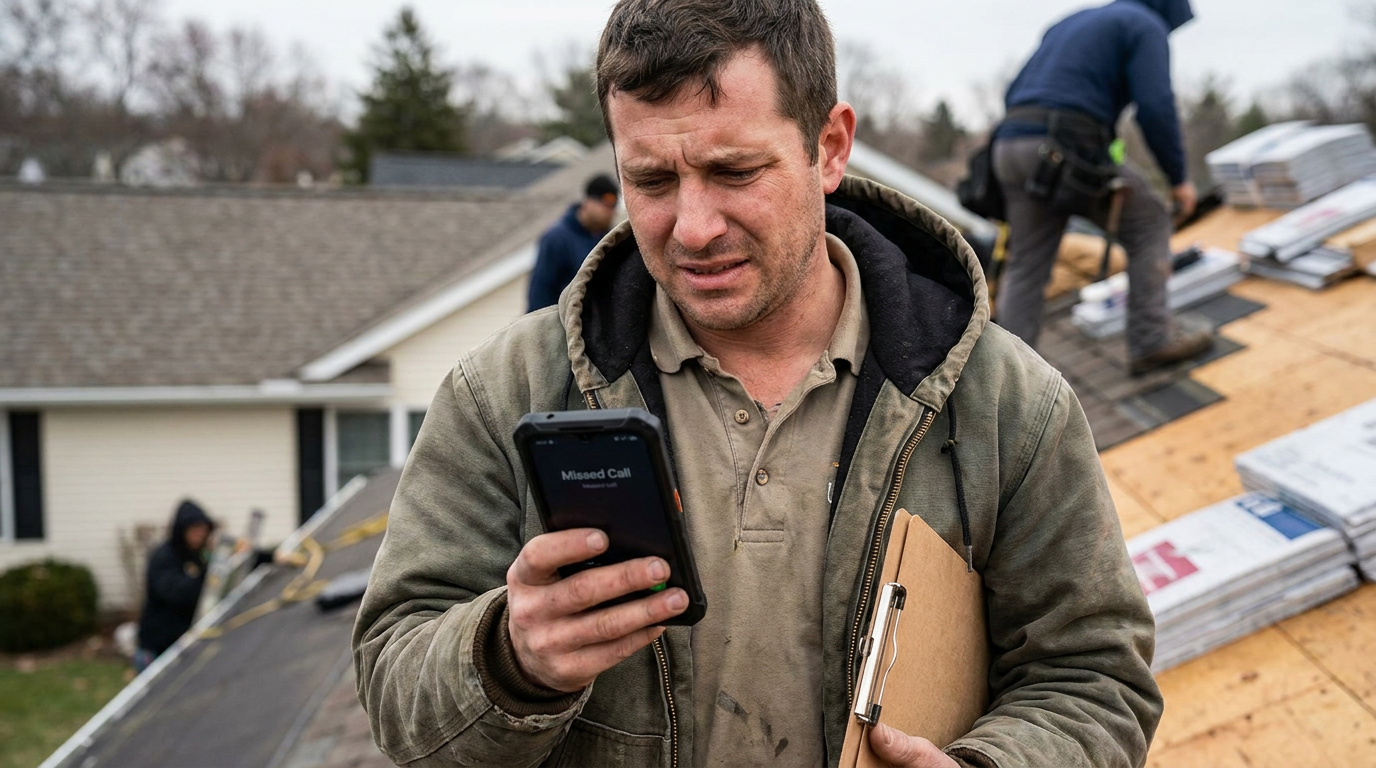
Your best closer is on a roof. Your office manager is buried in subcontractor emails. The phone rings four times, then goes to voicemail.
The homeowner doesn't leave a message. They call the next contractor on the map pack. A five-figure job is gone in under a minute, over something you'll never even see.
This is how good roofing and remodeling companies leak money every week. Not because of craftsmanship. Because of infrastructure.
That's the gap AI voice receptionists for home service providers are built to close — and it's the fix most successful contractors are missing.
What an AI Voice Receptionist Actually Does
Skip the tech talk. Here's what a system running quietly behind the scenes handles for you:
- Answers every call on the first ring — during job hours, after hours, weekends, storm season.
- Covers the common questions about your services, service area, and process.
- Runs real intake — address, job type, timeline, insurance status when it matters.
- Books the estimate straight onto your calendar and sends confirmation texts.
- Texts back every missed call within minutes, so nobody falls through the cracks.
- Flags urgent calls and routes them straight to your cell.
You don't manage it. Your crew doesn't touch it. The owner does what an owner should be doing: estimating, running jobs, and closing sales.
The Real Benefits of AI Voice Receptionists for Home Service Providers
These benefits stack up fast in the trades:
- Speed-to-lead. Homeowners researching a remodel compare three or four contractors in a row. If a missed call doesn't get a response within about three minutes, they've already moved to the next name.
- Nights and weekends covered. Big-ticket homeowners do their research after dinner and on Sunday. That's when your pipeline either fills or stays empty.
- Consistent intake. Every caller gets the same sharp questions. No sticky notes. No forgotten callbacks.
- A calendar that fills itself. On-site estimates get grouped and booked automatically instead of bouncing through phone tag.
- Less office burnout. Your staff handles the customers in front of them while the phone layer runs itself.
- Volume without hiring. Ten calls at once? Every one gets answered. No seasonal receptionist needed.
The Hidden Cost of Voicemail, Call Centers, and Cheap Workarounds
Compare that to what most shops run today.
Voicemail. Almost nobody leaves a message anymore. An empty inbox at the end of the day is an empty pipeline.
Answering services. They take a name and number and stop there. They don't know a supplement from a deductible, they can't book an estimate, and they won't follow up over the next three weeks.
An overloaded office. Permits, suppliers, scheduling, and a ringing phone all at once. Something drops, and it's usually the phone.
Expensive agencies. Plenty of contractors pay thousands a month for ads while calls still ring out on a Tuesday morning. Buying leads and fumbling the response is the most expensive habit in this trade.
Where This Fits: The Capture Stage of Monopolize
Our Monopolize system runs growth as one connected loop: Attract, Capture, Nurture, Close, Dominate. The AI voice receptionist lives in the Capture stage — the spot where money is won or lost fastest.
Capture doesn't work alone. The Attract side of the loop — local map pack rankings, background paid search, a strong footprint in AI search results — pushes more calls in, so the capture layer has to hold them. After the job, the Dominate stage runs automated post-job review requests and reactivates old estimates that never closed. Marketing, booking, and reviews become one loop instead of five disconnected tools.
That full build is what's deployed by EZtransition's Monopolize growth system. Sam, the AI employee at the center of it, answers the phone, books the estimate, follows up, and asks for the review — all in the background. It goes live in about 14 days and needs very little from you afterward.
What a Week Sounds Like When the System Is Running
Monday, 7:40 a.m. A hail-damage call lands during your crew meeting. The system answers, captures the address, notes the insurance carrier, and puts the inspection on Thursday's calendar. A confirmation text goes out on its own.
Wednesday, 8:15 p.m. A homeowner browsing kitchen remodel ideas sends a late-night message. She gets a fast, helpful reply by text, and an on-site estimate lands on Saturday morning. Your office opens at nine — the visit was already booked.
Friday, 4:15 p.m. A finished roof triggers an automatic post-job review request. The happy client posts five stars while the crew is still loading the trailer.
Nobody on your team touched any of it. That's the difference between a busy phone and a booked calendar.
Notes for Roofing and High-End Remodeling Operations
Storm surges. After a hail event, calls arrive in a wall. A front desk puts people on hold. An automated layer takes unlimited calls at once and qualifies every single one.
Insurance vocabulary. Storm callers ask about deductibles, claim scopes, and supplemental claims. Your intake should speak that language, not a generic script.
Designer-grade clients. Luxury remodel buyers browse late, expect polished text replies, and book around their own schedule. If the first impression is a voicemail box, they move to the next firm. These jobs are won on the on-site estimate, so the calendar has to fill itself.
FAQs From Roofing and Remodeling Owners
Will homeowners know they're talking to an automated voice?
The system answers quickly and professionally, and it never pretends to be a specific person on your staff. Most homeowners don't care who answers — they care that someone picked up on the first ring with a clear next step. That beats a voicemail box every time.
Can it actually book on-site estimates on my calendar?
Yes. It asks your intake questions, finds an open slot, and books the estimate directly onto your calendar, then sends confirmation and reminder texts. You start the day with a filled estimate schedule instead of a stack of callbacks.
What happens when a call needs a human?
Urgent or unusual calls get routed to your cell or to whoever you choose. Everything else gets a qualified message and an instant text follow-up. Nothing sits in voicemail limbo waiting to be checked.
Does this replace my office staff?
No. It takes over the phone traffic so your team can focus on the customers, paperwork, and jobs in front of them. Think of it as a receptionist that never calls in sick and never puts a caller on hold.
Will it hold up during storm season?
Yes. A front desk handles one call at a time; an automated layer handles many at once. When a hail event floods the line, every caller still gets answered, qualified, and booked instead of hearing hold music.
Pick One Hour and Find the Leaks
A quick note on trust: you've likely been overpromised by agencies before. Big talk, long contracts, nothing to show for it. This is a different approach — a fixed system, live in about 14 days, that keeps running without your daily attention.
If you want to see exactly where your pipeline drops high-value leads — the missed calls, the stale estimates, the slow review flow — book a zero-obligation Contractor System Audit. We map the leaks in your current setup. You decide what happens next.